LITERACY

SYNONYM STORIES
---
After a particularly challenging reading assessment, I noticed that my students needed more practice using guide words and reference materials. To build their understanding of these two topics, my students completed synonym stories by using a thesaurus. The students were given a silly story to complete in the style of Mad Libs but all of the blank spaces required a synonym rather than a specified part of speech. The students were required to use a printed thesaurus so that they could build their understanding of guide words, and then they also used Thesaurus.com in order to practice using digital reference materials. After completing this activity, the students shared their stories with a neighbor to compare how the use of synonyms changed their stories. When the students took a reading assessment the following week many more students were able to effectively analyze a question that utilized guide words!
Fact or Opinion Board Game
---
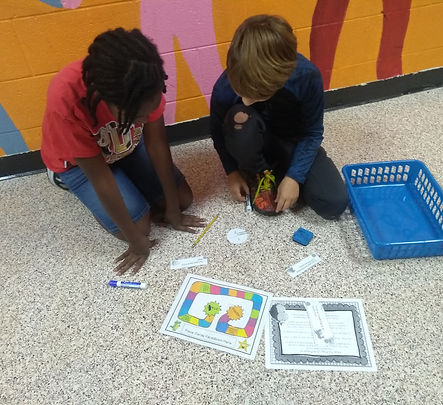
One of the ways that I engage students in building their reading skills is through games, as many students indicated games as a preferred way of learning on their interest inventories. On any given week, I will encourage students to engage in collaborative practice by playing an interactive game with their peers during Daily Three. In the game pictured, students practice determining if a statement is a fact or an opinion. In a small group, students read a statement aloud, determine if the statement was a fact or an opinion, and then check if their answer is correct using an answer key. If their answer is correct, they justify their response to their peer and then they move their game piece. By incorporating reading skills into games students receive additional practice with these skills in a fun and low-risk setting.


Author's Purpose Pear Deck
---
When beginning a new learning standard, I use pre-assessments to gauge my students' current level of understanding. Because my groups are fluid, I use that data to regroup and teach skills and content that are within each group's reach.
In this lesson, I used the Pear Deck platform to determine what my students knew about Author's Purpose. Each student had the presentation pushed out on their Chromebook screen and were able to anonymously engage in the activity. Even though their peers were unable to see their answers, their data was exported to a spreadsheet for me to see what each student knew. As a result, students were honest in their answers about what they remembered from the year prior. From this pre-assessment, I was able to determine which students had a firm grasp of Author's Purpose and which students might need more explicit instruction in the topic. Then, as the unit continued, I was able to provide differentiation in whole and small group instruction by focusing on different aspects of the topic each student needed to work on.